Trending...
- Mend Colorado Launches Revamped Sports Performance Training Page
- Northwest Modern Fabrication Expands Manufacturing Capacity With 4,800 Sq. Ft. Addition
- AI Layoffs Pushing Workers Into Startups—Most Will Fail From 'Startup Theater'
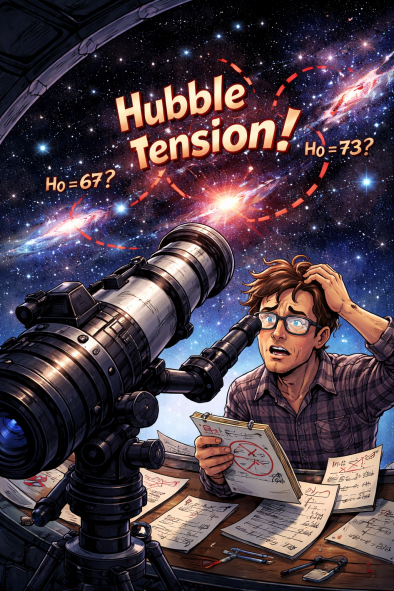
A newly published analysis proposes that the famous "Hubble tension" likely stems from an inference bias, occurring when standard General Relativity is applied to gravitational wave data that actually follows modified propagation.
HONOLULU - Marylandian -- The long-standing "Hubble tension"—a discrepancy between early-universe measurements of cosmic expansion and late-universe distance measurements—remains one of modern cosmology's most debated puzzles. While the discrepancy is often interpreted as evidence for new physics in the universe's expansion history, a new study proposes a different possibility: part of the tension may arise from how distances are inferred.
In a recent implications analysis, independent researcher Aiden B. Smith examines whether gravitational-wave distance measurements—specifically from so-called "dark sirens"—could be subtly affected by assumptions about how gravitational waves propagate across cosmological distances.
More on Marylandian
Dark sirens are gravitational-wave events without confirmed electromagnetic counterparts. Their distances are inferred statistically using galaxy catalogues. Smith's analysis uses his previously identified propagation anomaly in the GWTC-3 dataset as a template and asks: if gravitational-wave amplitudes decay slightly differently than predicted by General Relativity, what effect would that have on cosmological inference?
The study finds that, under this hypothesis, applying standard General Relativity during distance compression can induce a shift in the inferred Hubble constant of approximately +2 to +5 km/s/Mpc—comparable in scale to the observed tension.
Importantly, the paper does not claim to resolve the Hubble tension. Instead, it demonstrates that gravitational-wave propagation assumptions are not mathematically neutral: if even modest deviations are present, they can bias late-time inferences.
The modified-propagation preference identified in the GWTC-3 dark-siren sample has been subjected to internal calibration and stress testing, including injection-based null simulations and robustness checks against selection and catalog perturbations. While the signal remains statistically unusual within the tested framework, confirming its physical origin will require independent replication and larger gravitational-wave samples from future observing runs.
More on Marylandian
If confirmed, the results would suggest that part of the Hubble tension may reflect a subtle distance-inference effect rather than a fundamental breakdown of the expansion model itself. If not, the analysis provides a quantitative diagnostic of where dark-siren cosmology may be vulnerable to systematic effects.
The full study and reproducibility materials are publicly available.
Data and Study Availability: While the work is currently in peer review, the full study is available to read on Smith's research journal at quasardipolephenomenon.org. All code and reproducibility artifacts associated with this analysis can be downloaded via Zenodo (DOI: 10.5281/zenodo.18635659) or accessed on GitHub.
In a recent implications analysis, independent researcher Aiden B. Smith examines whether gravitational-wave distance measurements—specifically from so-called "dark sirens"—could be subtly affected by assumptions about how gravitational waves propagate across cosmological distances.
More on Marylandian
- "They Said It Was Impossible": This Bottle Turns Any Freshwater Source Into Ice-Cold, Purified Drinking Water in Seconds
- Smile Loft Dental at Hillandale Emphasizes the Growing Importance of Preventive Dentistry
- Patron Saints Of Music Names Allie Moskovits Head Of Sync & Business Development
- Riggo Productions The 2026 Official Media Content Studio of the Annapolis Blues
- Dave Aronberg Named 2026 John C. Randolph Award Recipient by Palm Beach Fellowship of Christians & Jews
Dark sirens are gravitational-wave events without confirmed electromagnetic counterparts. Their distances are inferred statistically using galaxy catalogues. Smith's analysis uses his previously identified propagation anomaly in the GWTC-3 dataset as a template and asks: if gravitational-wave amplitudes decay slightly differently than predicted by General Relativity, what effect would that have on cosmological inference?
The study finds that, under this hypothesis, applying standard General Relativity during distance compression can induce a shift in the inferred Hubble constant of approximately +2 to +5 km/s/Mpc—comparable in scale to the observed tension.
Importantly, the paper does not claim to resolve the Hubble tension. Instead, it demonstrates that gravitational-wave propagation assumptions are not mathematically neutral: if even modest deviations are present, they can bias late-time inferences.
The modified-propagation preference identified in the GWTC-3 dark-siren sample has been subjected to internal calibration and stress testing, including injection-based null simulations and robustness checks against selection and catalog perturbations. While the signal remains statistically unusual within the tested framework, confirming its physical origin will require independent replication and larger gravitational-wave samples from future observing runs.
More on Marylandian
- General Relativity Challenged by New Tension Discovered in Dark Siren Cosmology
- Unseasonable Warmth Triggers Early Pest Season Along I-5 Corridor
- Bug Busters Expands Service Footprint With New Carrollton, Georgia Branch
- Why KULR Could Be a Quiet Enabler of Space-Based Solar Power (SBSP) Over The Long Term: KULR Technology Group, Inc. (NY SE American: KULR)
- Why Finland Had No Choice But to Legalize Online Gambling
If confirmed, the results would suggest that part of the Hubble tension may reflect a subtle distance-inference effect rather than a fundamental breakdown of the expansion model itself. If not, the analysis provides a quantitative diagnostic of where dark-siren cosmology may be vulnerable to systematic effects.
The full study and reproducibility materials are publicly available.
Data and Study Availability: While the work is currently in peer review, the full study is available to read on Smith's research journal at quasardipolephenomenon.org. All code and reproducibility artifacts associated with this analysis can be downloaded via Zenodo (DOI: 10.5281/zenodo.18635659) or accessed on GitHub.
Source: Aiden Blake Smith
0 Comments
Latest on Marylandian
- Patent Bar Exam Candidates Achieve 30% Higher Pass Rates with Wysebridge's 2026 Platform
- Bestselling Author and Poet Uplifts Readers with Reflections on Faith, Resilience & Social Justice
- Municipal Carbon Field Guide Launched by LandConnect -- New Revenue Streams for Cities Managing Vacant Land
- Hoy Law Wins Supreme Court Decision Establishing Federal Trucking Regulations as the Standard of Care in South Dakota
- MWA Prince George's County Hosts Insightful Workshop with Author and Educator Jean Burgess
- Dr. Rashad Richey's Indisputable Shatters Records, Over 1 Billion YouTube Views, Top 1% Podcast, 3.2 Million Viewers Daily
- Grand Opening: New Single-Family Homes Now Open for Sale at Heritage at Manalapan
- Cécilia Brings Traditional Music and High-Energy Step Dancing to New Spire Arts
- Shelter Structures America Announces Distribution Partnership with The DuraTrac Group
- Maryland Agricultural Land Preservation Foundation (MALPF) Board of Trustees Meeting Notice
- Maryland Horse Industry Board Meeting Notice
- The OpenSSL Corporation Releases Its Annual Report 2025
- Maryland Agricultural Commission Meeting Notice
- Iranian-Born Engineer Mohsen Bahmani Introduces Propeller-Less Propulsion for Urban Air Mobility
- Aleen Inc. (C S E: ALEN.U) Advances Digital Wellness Vision with Streamlined Platform Navigation and Long-Term Growth Strategy
- RimbaMindaAI Officially Launches Version 3.0 Following Strategic Breakthrough in Malaysian Market Analysis
- Fed Rate Pause & Dow 50k: Irfan Zuyrel on Liquidity Shifts, Crypto Volatility, and the ASEAN Opportunity
- 20/20 Institute Launches Updated Vision Correction Procedures Page for Denver & Colorado Springs
- OneVizion Announces Next Phase of Growth as Brad Kitchens Joins Board of Directors
- New Children's Picture Book "Diwa of Mount Luntian" Focuses on Calm, Culture, and Connection for Today's Families